
Last week I was super excited to see the new gold Speedmaster Professional Apollo XI that commemorates the 50th anniversary of the Moon landing.But of course, it is also a tribute to the original gold Omega Speedmaster Professional Apollo XI 1969 that was presented to President Nixon, his Vice-President Agnew and to the astronauts of Apollo missions. Michael Stockton did a nice introduction article of the new 2019 Omega Speedmaster Apollo 11 50th anniversary and gave an overview (click here to read it) of the original BA145.022 and which numbers were given to which astronauts.I was so lucky to be in Bienne last week when the new Speedmaster Apollo 11 reference?310.60.42.50.99.001 was introduced. Even better yet, Omega gave me a prototype (nr. 0/1014) to wear for a while. This gave me the idea to compare it to the original Omega?Speedmaster Professional Apollo XI reference BA145.022-69 and see how close it actually is to it.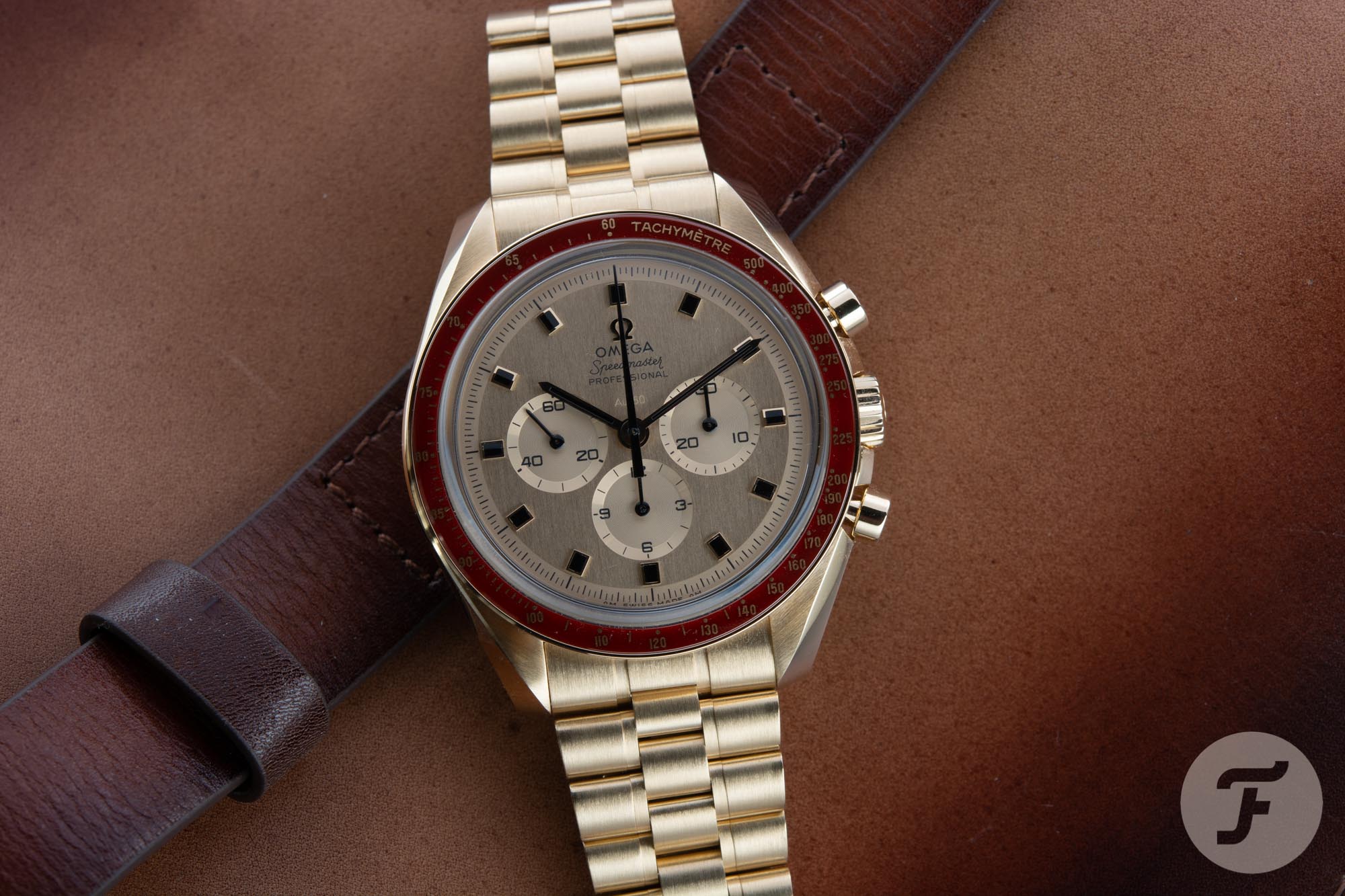 Hands-On With The Omega Speedmaster?310.60.42.50.99.001The first thing you will notice with this new gold Apollo XI watch on the wrist is the weight. A whopping 210 grams, which is much heavier than the normal Moonwatch in stainless steel. But most impressive is the appearance of this Speedmaster Apollo XI 50th anniversary, with its burgundy coloured bezel (ceramic), the polished Onyx hour markers, gold hands and the brushed gold dial. Oh, and lets not forget the re-interpretation of the original gold bracelet. It is simply stunning and wears amazingly comfortable. I?already expressed my hope to Omega that they will do one in stainless steel as well, in the future.? Then, there are all these details that Omega did so well in this new chronograph that pay tribute to the original watch. And to Apollo XI, of course.
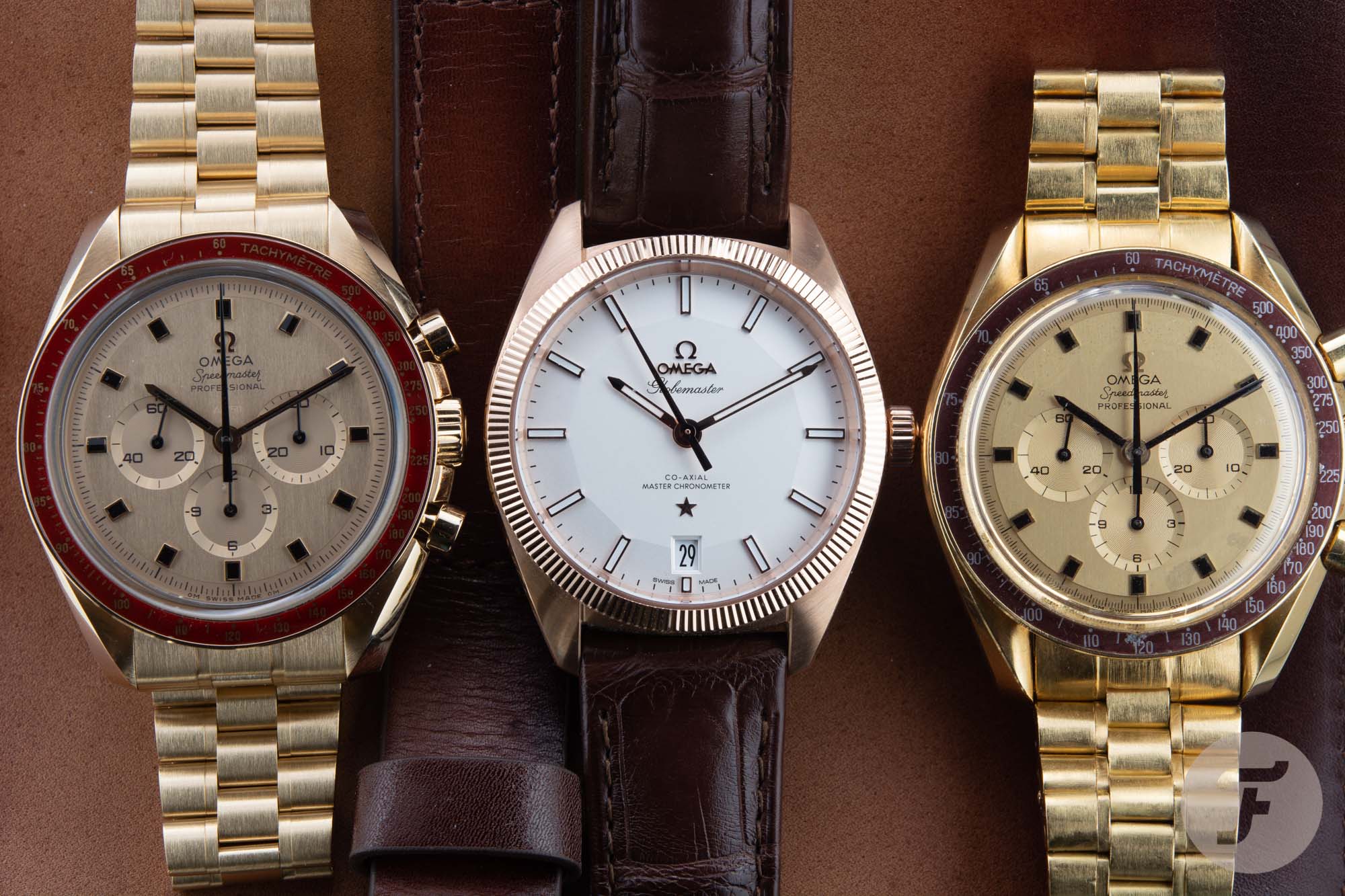
 Apollo XI Astronaut Buzz Aldrin with the new gold Speedmaster.When I got back from Switzerland, with the gold Speedmaster Apollo XI 50th anniversary proudly on the wrist, I couldnt wait to compare it to the original Speedmaster BA145.022-69 that we covered so often here on Fratello (like here, here and here). In 1980, Omega created another gold Speedmaster Apollo XI, the reference BA345.0802 (we covered it here) with a much lower production number (+- 300 pieces in total) than the 1014?watches of the 1969?model, but it is less popular by collectors. It might have something to do with the burgundy bezel and richer dial, but it could also just be that the history with the US President Nixon and astronauts speaks a bit more to peoples imagination. Later on, more yellow gold versions followed and eventually also became part of the regular collection (from 1999 until 2012).But this new Speedmaster Apollo XI 50th Anniversary is not really yellow gold, it is Moonshine gold, according to Omega. And indeed, the colour of this watch is a bit lighter than the 2N yellow gold that the 1969?version uses. Perhaps a bit more like the Moonlight, this Moonshine gold alloy has a bit more white tone to it. As you know,?18-carat gold is an alloy of gold (75%), copper and (often) silver. Now, you can play with the percentages of the other metals to get a certain colour. Omega decided to add Palladium, to get that paler hue. Also, the Moonshine gold colour has proper protection, it will last forever and keep the exact same colour.Only side-by-side you will discover that the Moonshine gold is much paler. Below, I show a photo of the new Speedmaster Apollo XI in Moonshine gold, the Omega Globemaster in Sedna gold (rose gold) and the 1969 Speedmaster Apollo XI in 18-carat yellow (2N) gold. You will quickly identify the different tones of these three gold colours.
 Speedmaster Apollo XI 1969 vs 2019Now, watch collectors and enthusiasts are always quick to state that you should always go for the original. In this case, the 1969 Speedmaster Apollo XI BA145.022-69. Prices are starting around 35.000 but more likely to be over 50.000 when in good collectors condition (with box and papers it will go up even more). The new Speedmaster Apollo XI 50th Anniversary has a retail price of CHF32.000 Swiss Francs (excl VAT), and in our own market, the official retail price will be 32.300,= (incl VAT). But is the original always better, or more interesting? I always tend to say yes myself, but thats mainly based on the (his)story of the watch. When you look at it purely from a product perspective, it might be different. Lets have a closer look at both gold Speedmaster Apollo XI watches and see what I prefer myself: the original or the 2019 tribute.Omegas Comparison ImageOmega did their homework and in their press release of this watch, you can already find a nice comparison between the 1969 and 2019 Speedmaster Apollo XI. The image below shows you the main difference between these two watches. Most important differences are of course the gold alloy, the use of ceramic for the bezel and, of course, the new caliber 3861 movement.
 Small Differences On The DialWith these two watches in front of me, the vertically brushed finish is easier to admire on the new Speedmaster Apollo 11 50th anniversary than it is on the BA145.022-69. It might be the age of the watch, or simply the more yellowish colour, but the vertical brushed finish shows off better on the new dial. Both dials have the step, what Omega let go off in 1974 for their Speedmaster Professional watches. Whats interesting, is that Omega respected the OM (Or Massif) next to Swiss Made to indicate the use of a solid gold plate for the dial. Also, the onyx hour markers have exactly the same shape (two facets). Whats different on the dial, are mainly three things. The positioning of the Omega logo and writing of OMEGA and Speedmaster Professional. On the new Speedmaster Apollo XI 50th anniversary edition, this is positioned a bit more towards the marker at 12 oclock. This might have to do with the Au750 engraving above the center pinion, but I am not sure. It does at least look a bit more spacious.
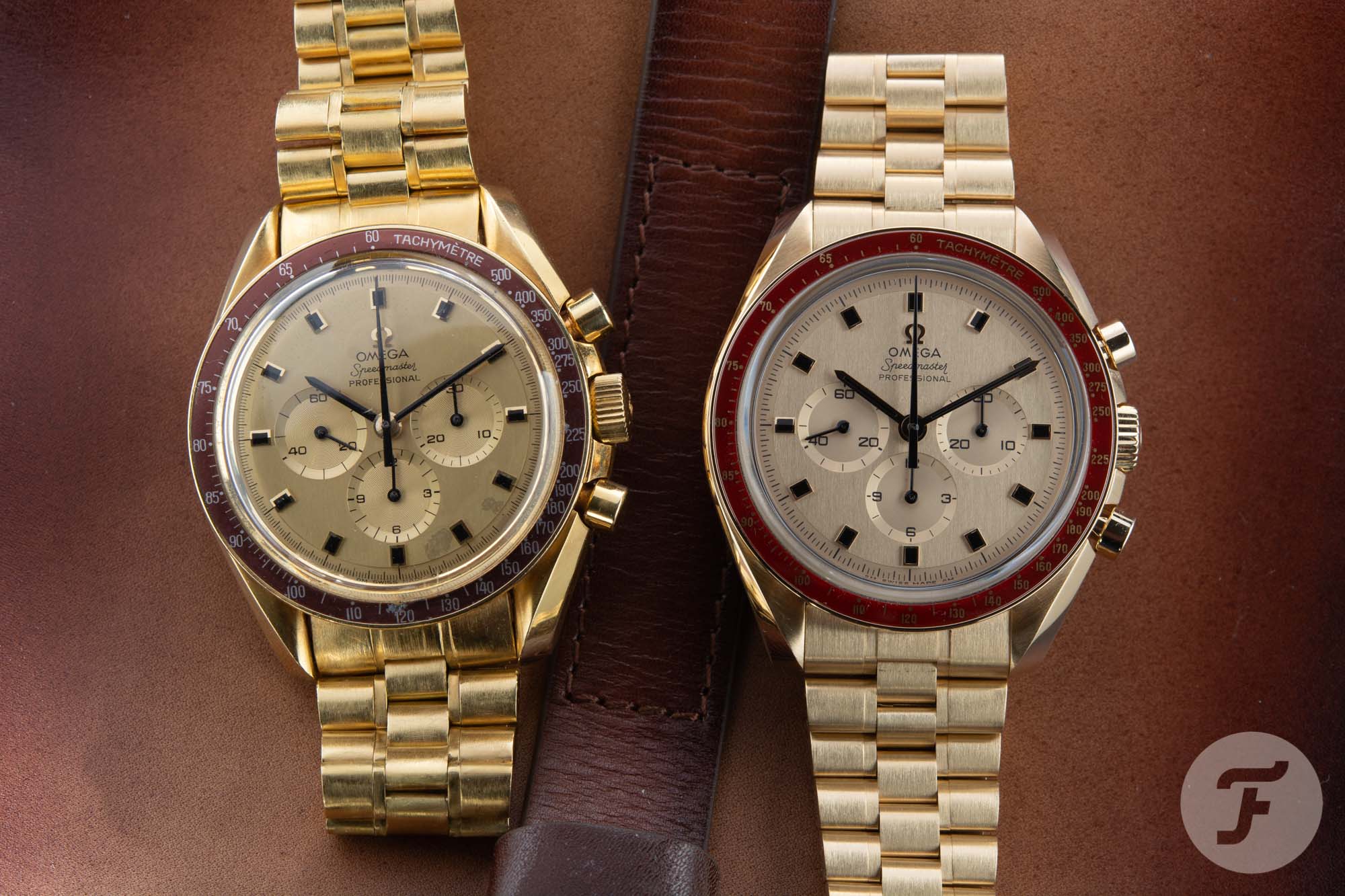 The second difference is the markers for the seconds, between the minute markers. On the Speedmaster BA145.022-69, you will find 4 indices between the minute markers. On the new version, there are only two. You will find that most Speedmaster variations have 4 indices between the minute markers, but more recent models only have two of them (f.i. the new CK2998, the Speedy Tuesday models etc. According to Omega, using the chrono division per 5 seconds is heritage from the old caliber 321 movement with a 2.5hz frequency that can measure 1/5th of a second. Since the caliber 861, the movements run at (21600vph) 3hz which can measure 1/6th of a second (so a chrono division per 3 seconds). Omega never corrected this properly for the regular Moonwatch models but started to do so in 2003 with the Moonphase model and in 2010 with the Apollo-Soyuz 35th anniversary edition.
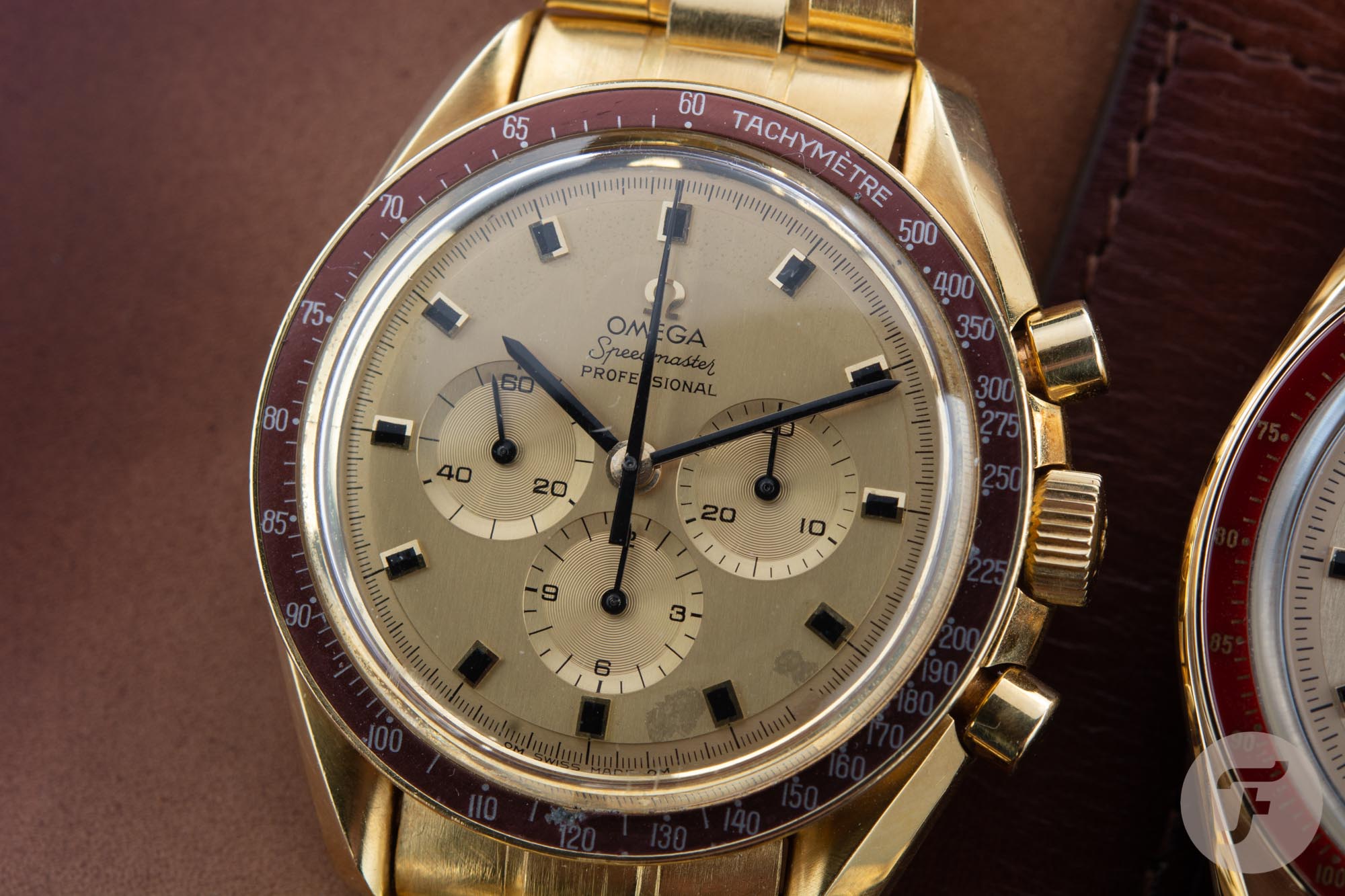
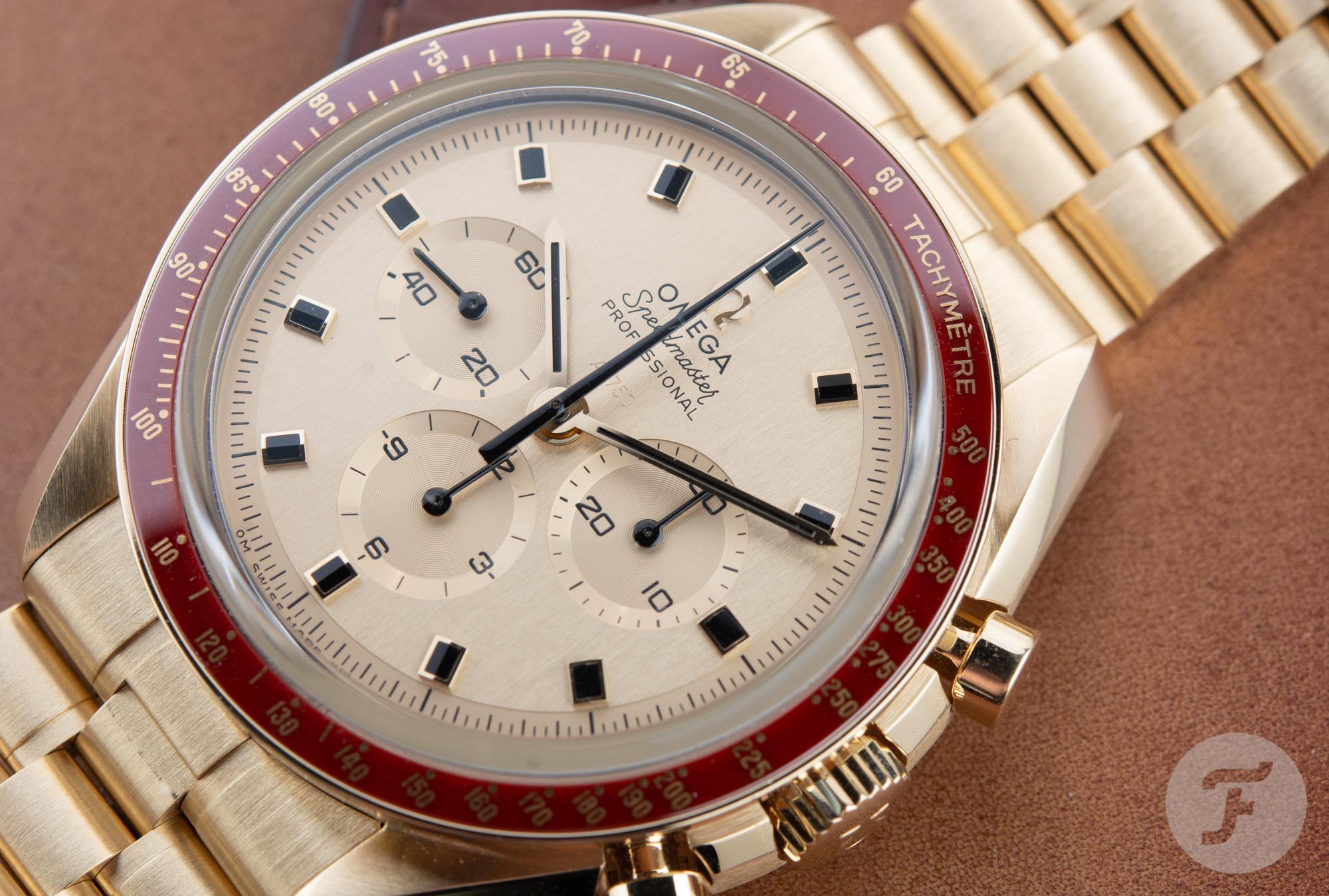 The third difference with the BA145.022-69 is that the new edition has gold hands instead of black hands. Although it might appear to be black hands on some of the images, including the original Omega press images, these are also in Moonshine gold (see above). Since they are highly polished, they are difficult to capture as such on camera as they reflect the lens or camera. The gold hands are filled with black varnish, not Super-LumiNova. The large seconds hand and the three small hands are all black varnish. So, to be clear, just like the BA145.022-69, the new reference?310.60.42.50.99.001 also does not illuminate in the dark due to the lack of lume. So you will need a bit of light to read the time. Or grab your iPhone.Burgundy Bezels And SapphireIt is impossible to honor the 1969 gold Speedmaster Apollo XI without doing a watch with a burgundy bezel. Now, Omega already showed us something in red last year, when they introduced the Speedmaster Tokyo 2020 watch with a red bezel that we refer to as The Rising Sun, but this new ceramic bezel is even more close to the original burgundy. Where the original Speedmaster Apollo 11 1969 uses aluminium, and the Rising Sun as well, the new gold Speedmaster Apollo 11 has one made of ceramic. Ceramic (ZrO2) in burgundy?with the scaling in Omegas Ceragold. Originally, the scaling was in metallic grey. The new ceramic bezel looks amazing, especially when it catches the sunlight. Omega respected the famous DON indicator (Dot-Over-Ninety) for this bezel scale.Below, an image of the original Speedmaster Apollo XI with an aluminium bezel. As you can see, it has some damage to it which is perhaps quite normal when a watch is 50 years old. The new ceramic model will look the same in 50 years from now though.
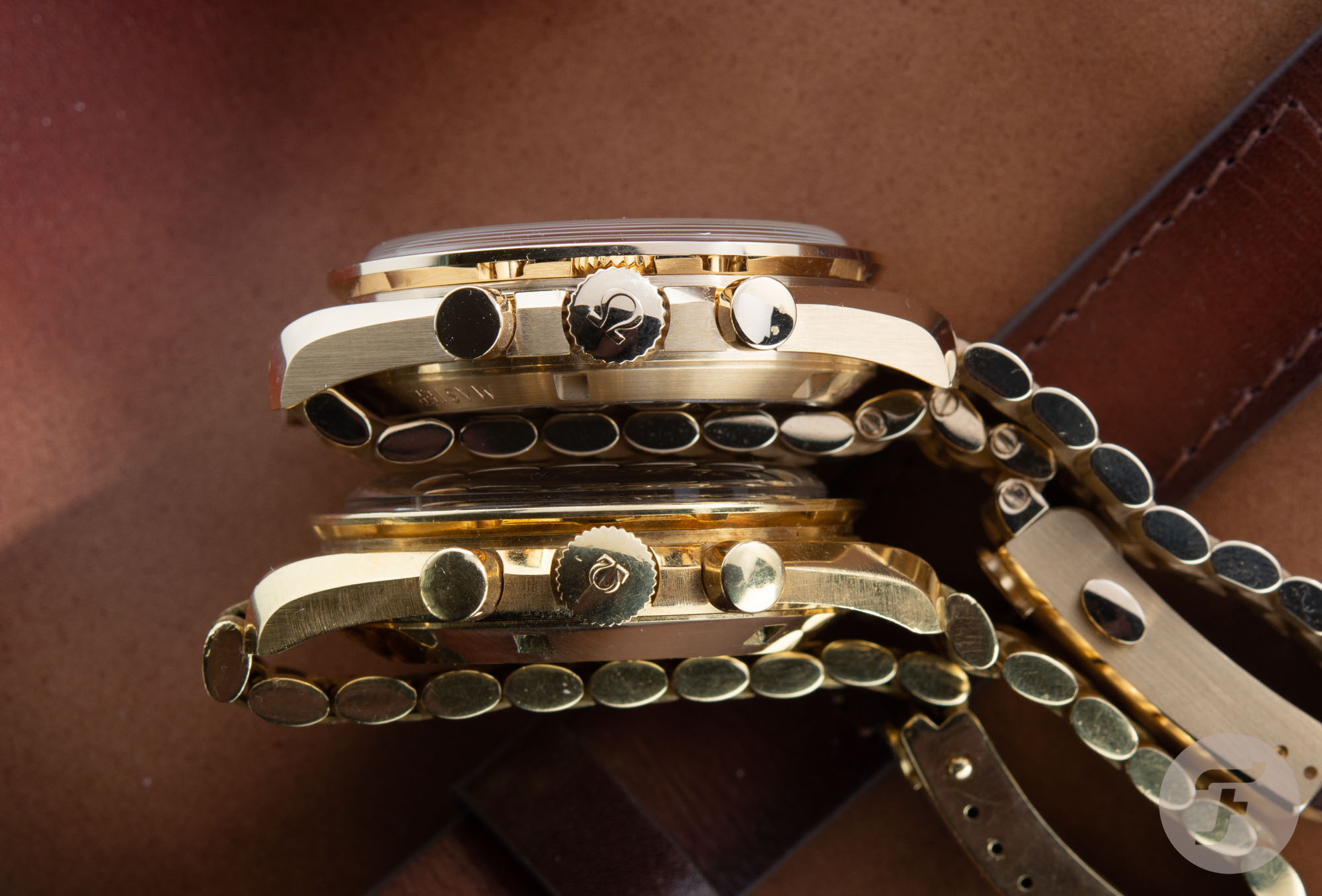
 Instead of Hesalite (plexi crystal), the 2019 Speedmaster Apollo XI in gold uses a sapphire crystal. Sapphire adds a bit to the weight of the watch, but it especially gives a more clear view at the dial. I personally love Hesalite, as it has the tendency to magnify the dial a bit, making the watch face look bigger than it actually is. The sapphire crystal is boxed, but the Hesalite seems to be positioned a bit higher. The profile of the watch, as can be seen below, is very similar though.
 BraceletJust like the original bracelet (reference 1116/575), the new one tapers from 20mm between the lugs to 14mm to the clasp. The design of the bracelets are identical, which was something I hoped for. Also for the steel models to come, I hope they will go back to a previous design as I am not a fan of the current stainless steel Speedmaster bracelets.
 Back to the gold bracelet: at least compared to the 18mm clasp on the later models or even the 16mm on my own gold Speedmaster Apollo XI from 1980, 14mm is quite small. In the flesh though, I have to say that on the original 1969 edition it is indeed small, but the new watch has a clasp that has a bit more body and is, therefore, thicker than the old one. Not only that, but the folding mechanism is also more solid. In fact, the entire new bracelet is very solid (and thus heavy) compared to the vintage Speedmaster Apollo XI 1969 edition. Although the outer links of the 1116 bracelet are solid gold, the center links are hollow. The new bracelet has 5 rows of solid gold links and probably makes up quite a bit for the heavier weight of the watch in total. The new Speedmaster Apollo XI weighs 210 grams where the 1969 model shows 167 grams on my scale. The sapphire crystal on the new watch is also part of the heavier weight, of course.
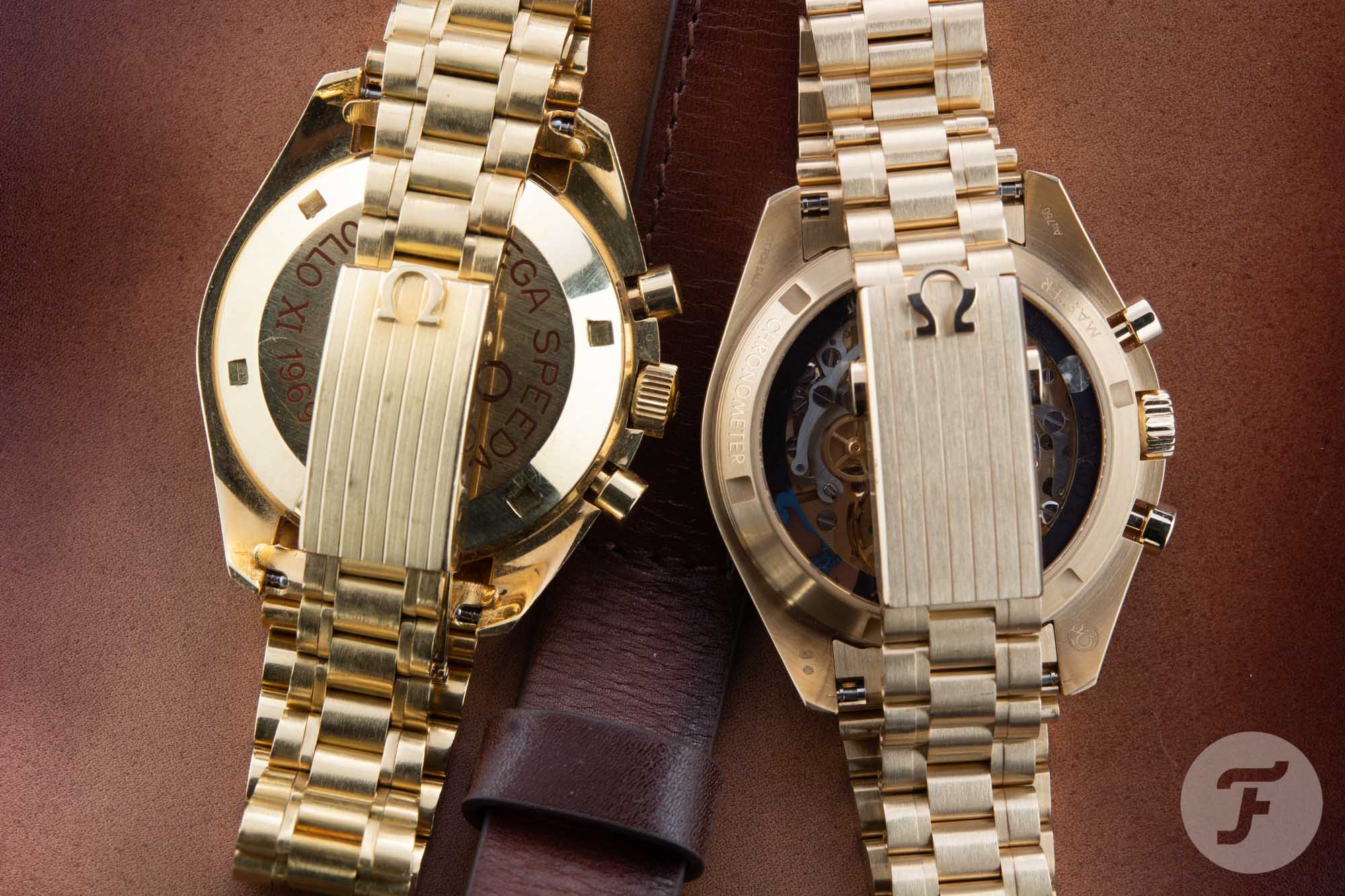
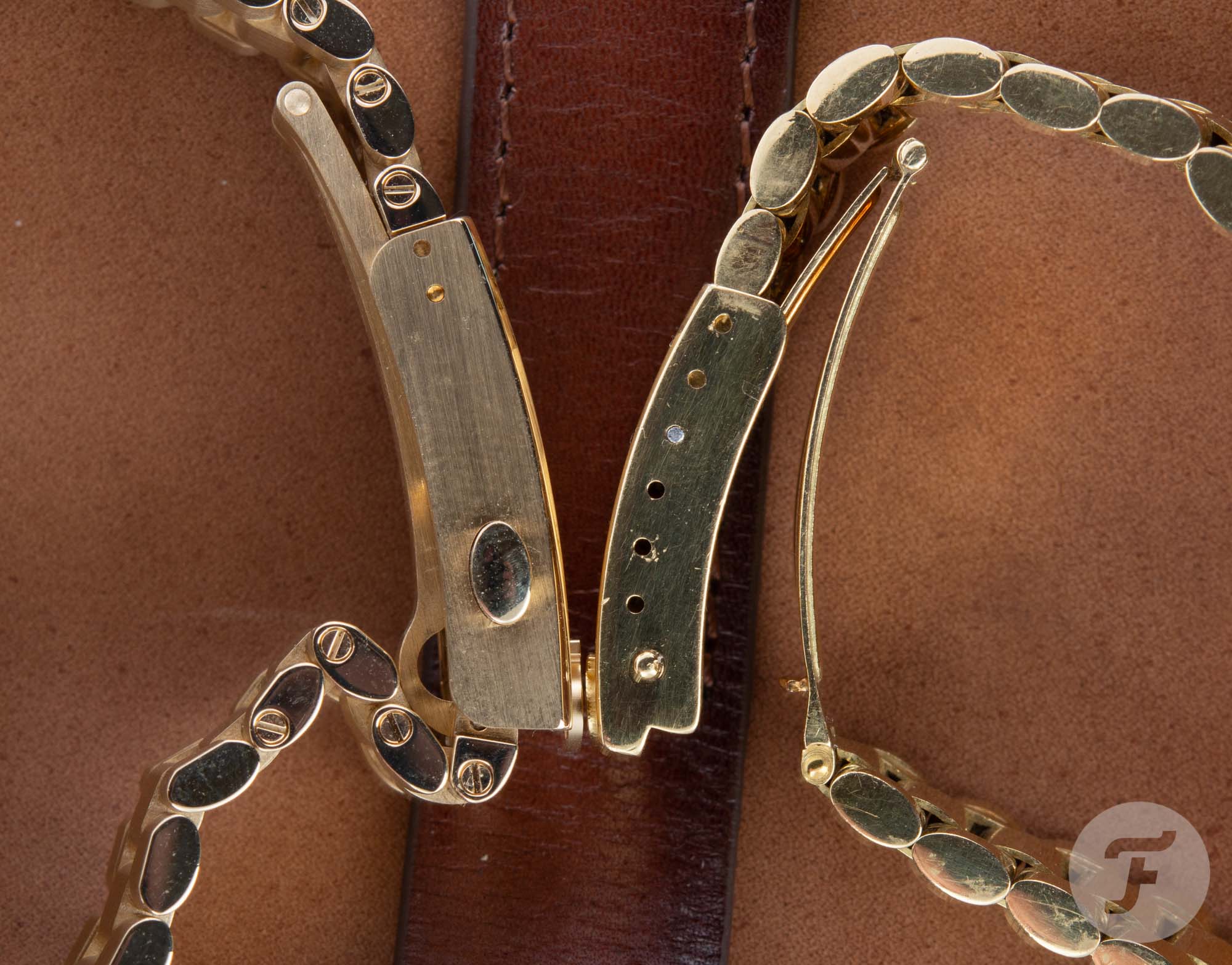 The new bracelet has screwed links and the clasp uses two pushers to release. I love the new bracelet so much, it is very pleasing for the eyes and it wears super comfortable. I also love the design of the clasp, where they respected the original design as much as they could. The pusher system also works safer than the former click system. You dont want to lose this watch, for sure.Caliber 3861 Master ChronometerOne of the biggest surprises you will find on the case back of the Speedmaster Apollo XI 50th anniversary. Where the original version had a solid gold case back with an inscription (in fact Omega had several iterations of this gold case back between 1969 and 1973), the new version has something special. Well, two things actually.First, theres a new movement. Caliber 3861. Although it might sound like a caliber 1861 (the original gold Apollo XI has a?caliber 861 movement) with something extra due to the change of the first digit, Omega changed approximately 50% of the parts used in this movement. Besides that, the movement indeed has a Co-Axial escapement and is certified as Master Chronometer. This means, that it is anti-magnetic up to 15,000 gauss and has a balance with a silicon spring. Where the normal caliber 1861 has an accuracy between -1 and +11 seconds a day (these are the margins for the Moonwatch), the new caliber 3861 maintains the Master Chronometer standard by using a deviation of +-0 to +5 seconds a day on average.Interesting to note is that the watch has a power reserve of 50 hours (compared to the 48 hours of the caliber 1861/1863), but thats with the chronograph running. Without the use of the chronograph, the power reserve is +- 60 hours. The caliber 1863 consists of 240 parts (whereas the caliber 1861 has 234 parts). Another important difference is that the caliber 1863 has a hacking feature, so the balance wheel will stop in the 1st position of the crown.
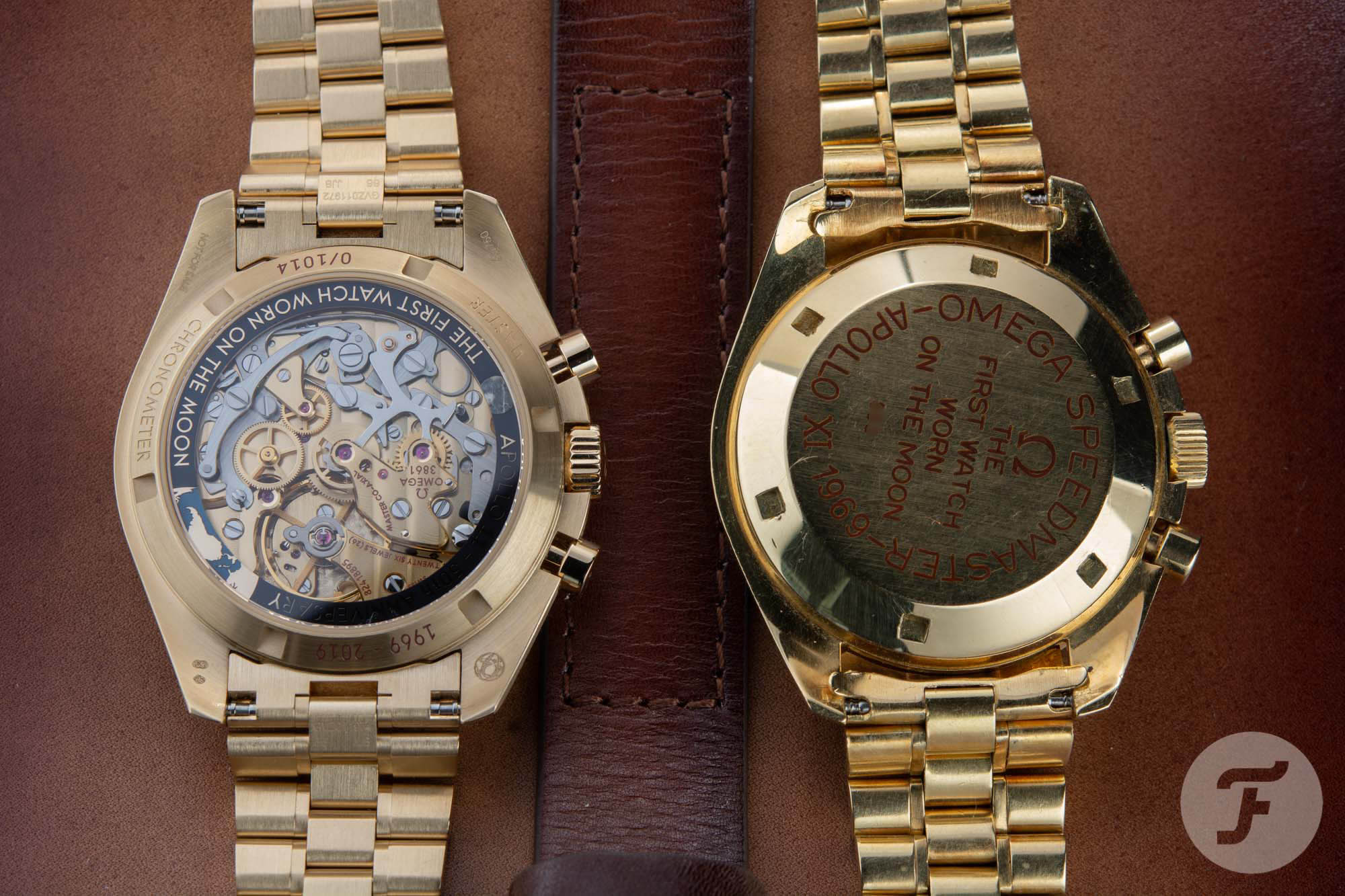 Some people were a bit put off by the fact that this gold Speedmaster Apollo 11 50th anniversary does not feature the caliber 321, but I am actually happy it doesnt. Not only because then the indices between the minute markers would be incorrect again, but more importantly because the original BA145.022 also did not have the L|mania based caliber 321 movement. How much I love the caliber 321, it simply doesnt belong in this watch. You can debate or argue whether a display back belongs to this Speedmaster Apollo XI in gold, as the original has a solid gold case back with inscription, but technically speaking the caliber 3861 is closer to the (1)861 than to the caliber 321. But no worries, a watch in precious metal with caliber 321 will be announced (probably soon).The finish of the caliber 3861 is pretty cool, and nicer looking than the standard 861/1861 movements. It is more like the later 863 and 1863 movements, that had a higher grade finish because these were used for Speedmasters with display backs. Just like those 863 movements with copper-coloured parts, this new caliber 3861 also has a similar colour. Omega used Moonshine gold plating for the main plate and bridges. All the engravings on the movement are filled with a burgundy colour. Furthermore, you will find the C?te-de-Genve finishing on the bridges, beautifully polished levers and bevelled?bridge?edges.