
Youre probably familiar with astronaut Ed White, who performed NASAs first spacewalk in 1965 as part of the Gemini IV mission. On the pictures of that spacewalk, you can see him wearing two watches.Unfortunately Ed White died in the fatal accident with Apollo 1. His name will live forever though, as the man who performed NASAs first spacewalk in 1965. He was also part of the Apollo 1 crew, that should have launched on February 21st. However, during a test on January 27th, the crew (White, Grissom, and Chaffee) all died in a horrible fire in the command module.Amongst Speedmaster collectors, Ed White is often referred to when it comes to the Speedmaster 105.003 reference. This is the Speedmaster reference that Ed White wore during his Gemini IV flight and spacewalk, and also what was on his wrist during that fatal accident. A few questions arise when seeing Ed White wearing two Speedmasters over his spacesuit. Why did he wear two watches? Which specific watches did he wear and where are they now? Ed White wearing two Speedmaster 105.003 watchesSpeedmaster Ed White 105.003With the help of Omega and the brands access to the NASA archives, well try to answer those questions. Although many assumptions have been made on this topic, it is good to have our research fact-checked by Omega (and, via Omega, by NASA).The 105.003 reference was the watch that was tested and qualified by NASA for all manned space missions in 1965. NASA initially received three of these watches to be tested. After the qualification, Omega sent another batch of 24 Speedmaster 105.003 watches. Later on, NASA also ordered the Omega Speedmaster Professional 105.012 and 145.012 references for use during Apollo missions. The 105.003 was used at the same time as the 105.012 and 145.012. Consequently, all three references were issued until the end of the Apollo missions.
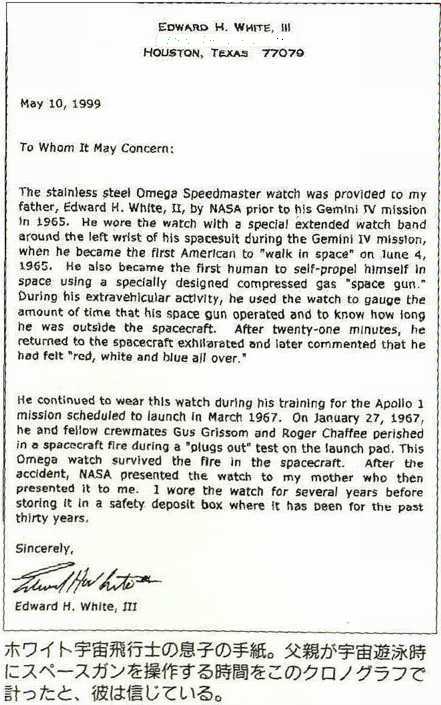
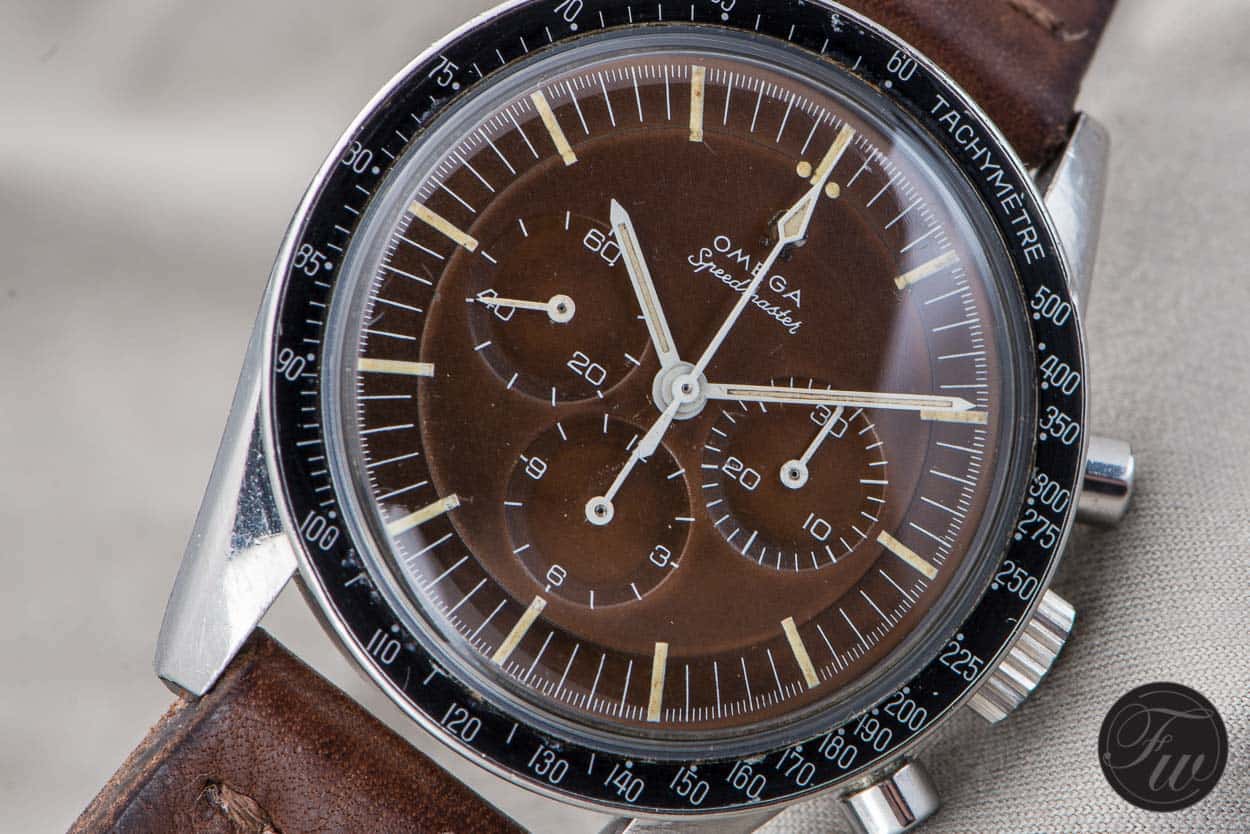 Speedmaster 105.003-63Omega confirmed that both watches on the wrist of astronaut Ed White during the Gemini IV mission are Speedmaster 105.003-63 references. One of them was Ed Whites training watch, and, according to NASAs former engineer James H. Ragan, It was one of the first Speedmasters to be delivered after the tests performed by NASA. The training watch was later sold by Ed Whites son to a collector in Japan. The late Chuck Maddox wrote about this on his website.
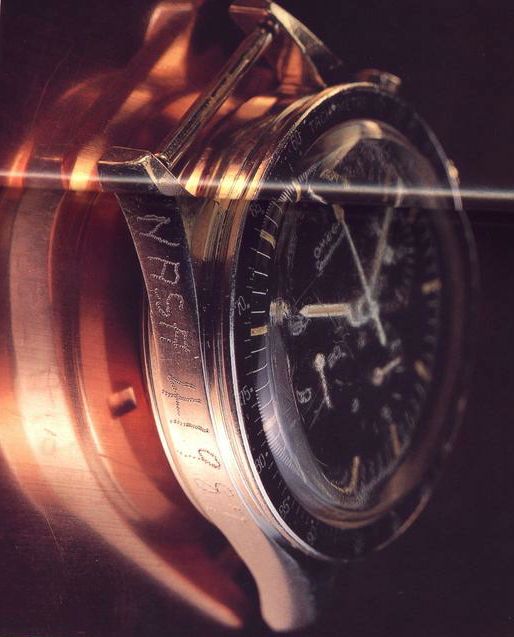
 What we know, is that the other 105.003-63 watch was destroyed in the fire of Apollo 1. This watch had NASAs internal serial number S/N 5 and reference code CF5503 engraved on the left side of the case. On the case back, it was engraved with SEB1210039-001.NASA engravingsWith the 105.012 and 145.012 references, the NASA number changed from -001 to -002 and the CF5503 coding was shelved. Interestingly, the CF5503 engraving was originally meant for Gemini missions. The SEB1210039-001/002 engraving was for Apollo missions. The watches that were used for Gemini, and thus only had CF5503 to start with, were redone with the additional SEB1210039-001 engraving. These codes were internal reference or product numbers for identification. Every piece of equipment NASA used was labeled and categorized in a similar way.
 Omega serial numbersThat answers the question of what happened to these two Speedmaster 105.003-63 watches. Unfortunately, that means it is difficult to find out the exact Omega serial numbers of these watches. We do, however, know roughly where those serial numbers would have fallen. From the archives, we can tell that the serial numbers would have started with 202526xx. The last two digits seem likely to remain unknown.The other astronaut on Gemini IV was the command pilot James A. McDivitt. McDivitt was also the commander on Apollo 9. He also wore a Speedmaster during the Gemini IV mission. This was also a reference 105.003-63 with NASAs S/N 4 CF5503 and SEB1210039-001. This watch is conserved at the Smithsonian in the USA. The Omega serial number of this watch is also in the 202526xx range. Interestingly,? this particular watch was later on used by astronaut Borman during Gemini VII.Why Ed White wore two watchesAccording to NASAs former engineer James H. Ragan, astronauts kept track of the mission time, but also of their home (Houston) time. The same applied to Ed White during his 23-minute-long spacewalk in 1965. One Speedmaster 105.003-63 indicated the mission time of Gemini IV, the other one was set to Houston time.We hope that this article will bring some clarity to the exact type of watches that Ed White wore in space, where these watches are today, and why he wore two.Also, I would like to thank the Omega Museum and former NASA engineer James H. Ragan for their cooperation.